This content is for informational purposes only. I’m not providing medical or nutritional advice. Diet needs vary by individual—consult a qualified professional before making changes
Most keto meal plan fails, you know why? because one boring reason: they don’t actually hit keto macros at a real calorie level. They’re either accidental low-calorie diets or cheese-and-bacon binges that wreck lipids and digestion.
What you’ll find in this article
- A true 2000 kcal/day structure (not vibes)
- Clear keto carb targets (net and total)
- A done-for-you 7-day plan that actually adds up
- Swaps so you don’t quit on day 10
- A shopping list + prep system that saves time
- A blunt “Should you even do keto?” section
Medical reality check (don’t skip):
If you’re on insulin or sulfonylureas, pregnant, have kidney disease, or a history of eating disorders, keto is not a casual experiment. You need medical supervision. That’s not me being dramatic—that’s standard clinical guidance (see Virta Health’s physician-led keto protocols)
The 2000-calorie structure (so this is repeatable)
Daily setup (works in real life)
- 3 meals + 1 snack
(or 2 meals if you do IF—same macros)
Every day includes:
- 1 high-protein anchor
- 2 high-veg meals
- 1 fat lever (easy calorie control)
Portion strategy that actually hits 2000
You don’t eyeball keto. You adjust fat.
Reliable calorie levers:
- +1 tbsp olive oil → ~120 kcal
- +½ avocado → ~130 kcal
- +30 g nuts → ~180 kcal
- +30 g cheese → ~110 kcal
Protein and veg stay stable. Fat moves.
The actual 7-day 2000-calorie keto meal plan
Now you’ll see the actual meal plan around 2000 calories. This is just a format sample; you don’t need to strictly adhere to this. You can change any meal if you want.
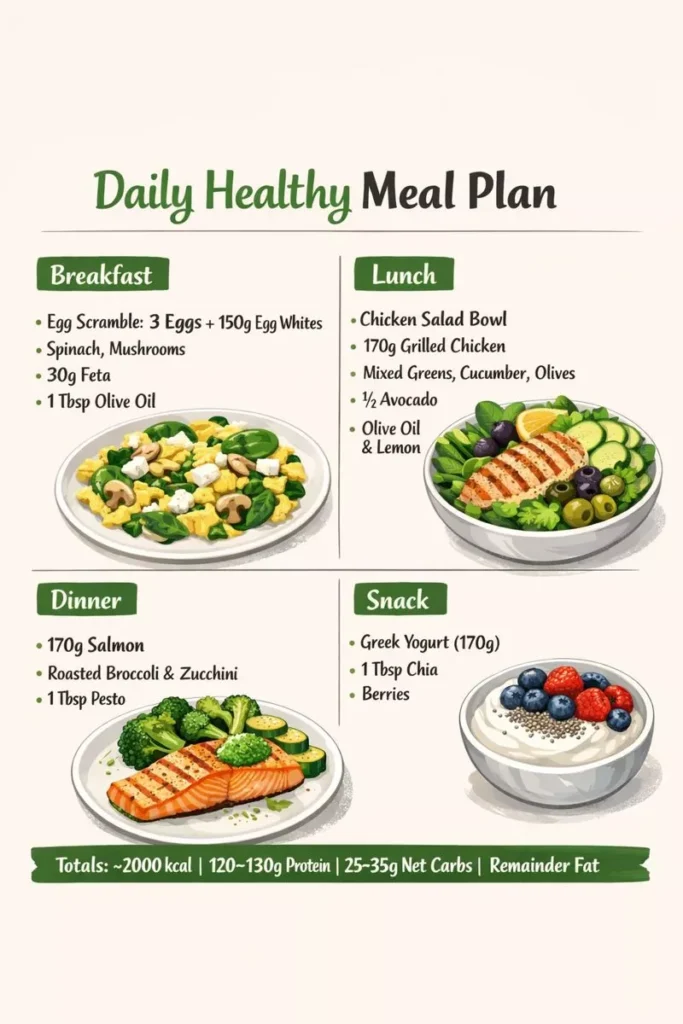
Format (example day)
Breakfast / Brunch
- Egg scramble:
- 3 whole eggs + 150 g egg whites
- Spinach, mushrooms
- 30 g feta
- 1 tbsp olive oil
Lunch
- Chicken salad bowl:
- 170 g grilled chicken
- Mixed greens, cucumber, olives
- ½ avocado
- Olive oil + lemon
Dinner
- 170 g salmon
- Roasted broccoli & zucchini
- 1 tbsp pesto
Snack
- Full-fat Greek yogurt (170 g)
- 1 tbsp chia
- Few berries
Totals: ~2000 kcal | ~120–130 g protein | ~25–35 g net carbs | remainder fat
1. What does “Keto” actually mean (and where people lie to themselves)
The non-negotiables of nutritional ketosis
Keto is defined by carb restriction, not by drowning food in fat.
Real-world effective ranges:
- 20–50 g carbs/day works for many people
- <30 g/day is where ketosis becomes reliable for most adults
If you’re eating 60–80 g carbs and calling it keto, you’re just on a low-carb diet. That’s fine—but call it what it is.
Net carbs vs total carbs (this is where people mess up)
Net carbs = total carbs – fiber – some sugar alcohols.
Here’s the hard truth: net carbs are easy to abuse. Keto products lean on “net” math to hide overeating.
Practical rule from experience:
- If keto isn’t working → track total carbs for 2 weeks
- If it is working → net carbs are fine
Fiber subtraction doesn’t make carbs disappear metabolically if you’re overeating calories or processed “keto” foods. This is why people stall.
2. Your 2000-calorie keto macros (clean math, no BS)
Standards of keto macro range ( reality, not dogma)
Most defination land around:
- 70–75% fat
- 20–25% protein
- 5–10% carbs
That’s a range, not a religion.
A realistic 2000-kcal template (two options)
You’ll get two options,
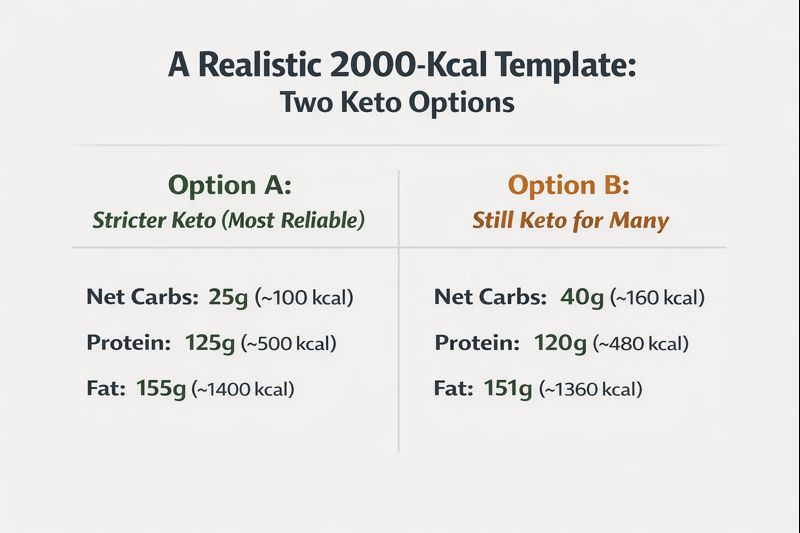
Option A: Stricter keto (most reliable)
- Net carbs: 25 g (~100 kcal)
- Protein: 125 g (~500 kcal)
- Fat: 155 g (~1400 kcal)
Option B: Still keto for many
- Net carbs: 40 g (~160 kcal)
- Protein: 120 g (~480 kcal)
- Fat: 151 g (~1360 kcal)
If you’re active, lifting, or bigger-bodied, you’ll likely land closer to these protein numbers. Anyone telling you “protein kicks you out of ketosis” is oversimplifying outdated theory.
Protein guardrails (why “moderate” matters)
Here’s what actually happens:
- Too little protein → hunger, muscle loss, stalled fat loss
- Too much protein → ketosis can be harder for some (not all)
Set protein first based on body size and activity. Then use fat to hit calories. Keto fails when people do the opposite
3. The part keto influencers avoid: heart health
Keto can spike LDL (yes, even if you lose weight)
Some people see dramatic LDL increases on butter-heavy keto. This isn’t controversial anymore. Even low-carb researchers acknowledge it.
Harvard’s take (worth reading, not keto-hostile, just honest):
Saturated fat vs keto reality
Most guidelines still recommend <10% of calories from saturated fat (≈20 g/day on 2000 kcal). Traditional keto blows past that.
The smarter keto compromise (what actually works long-term):
- Base fats: olive oil, avocado, nuts, seeds
- Proteins: fish, chicken, turkey, eggs, limited fatty red meat
- Use butter, cream, cheese as accents, not foundations
This is closer to a Mediterranean-keto hybrid, and lipid panels tend to look much better. I’ve seen it repeatedly.
4. Keto flu prevention (because suffering isn’t discipline)
Electrolytes (most plans screw this up)
Low insulin → kidneys dump sodium → everything feels terrible.
Baseline targets:
- Sodium: ~4–5 g/day (yes, grams)
- Potassium: food-first (avocado, leafy greens)
- Magnesium: 300–400 mg/day (glycinate or citrate)
Symptoms you’re low: headaches, cramps, fatigue, “keto flu.”
This isn’t detox. It’s electrolytes.
NIH magnesium reference (not keto propaganda):
Fiber on keto (without blowing carbs)
You don’t need “keto bread.” You need plants.
Best options:
- Leafy greens, broccoli, zucchini, mushrooms
- Chia, flax
- Psyllium if needed
Constipation fix checklist:
- Water
- Magnesium
- Vegetable volume
Still stuck? You’re under-eating fiber, not “adapting.”
Final Thoughts
I hope this full guide helps you a lot.
Now you have a wealth of information about the keto diet, along with a proper 7-day, 2000-calorie keto meal plan.